Sandton is the one part of our patch where “DStv installation” rarely means climbing onto a pitched roof. Between Sandton City, Nelson Mandela Square and the ring of office and residential towers along Rivonia Road, Katherine Street and Maude Street, most of our callouts here are inside sectional-title apartment blocks or commercial premises — which changes the job more than people expect. This page covers how we handle installs, repairs and multi-room setups in Sandton specifically: body corporate sign-off, communal dish systems, bracket rules on balconies, and the handful of freestanding pockets that still exist at the edges before the suburb gives way to Morningside and Sandhurst.
Sandton Central: towers, body corporates and life above the street
Sandton is often called the richest square mile in Africa, and it’s not much of an exaggeration — the Johannesburg Stock Exchange has been headquartered here since 2000, the Sandton Convention Centre anchors the area’s conference trade, and the Gautrain’s Sandton station is the busiest on the network. What that means for us on the ground is a suburb built vertically rather than horizontally. The Leonardo on Maude Street rises roughly 150 metres above the skyline with luxury apartments stacked above office floors, and developments like The Capital on the Park on Katherine Street have added hundreds more sectional-title units within a few blocks of Nelson Mandela Square. Between these towers sit older, lower-rise blocks from the 1990s and early 2000s, plus a shrinking number of freestanding homes on the quieter streets toward Benmore and Atholl.
That density means almost every install we do in Sandton Central involves a managing agent or body corporate somewhere in the process — whether that’s getting written permission to fix a bracket to an external wall, coordinating roof access with the building’s maintenance team, or working around a communal satellite system that’s shared between dozens of units.
Getting around Sandton Central’s precincts
Sandton City itself sits at 83 Rivonia Road, on the block bounded by Alice Lane, Fifth Street and West Street, linked by an internal skywalk to Nelson Mandela Square next door. The Gautrain station is built beneath Rivonia Road, with its main pedestrian entrance at the Rivonia Road/West Street corner — which is why so much of the newer residential stock, including The Leonardo and The Capital on the Park, has gone up within a short walk of that corner rather than spread evenly across the suburb. Alice Lane in particular has become its own mini-precinct of office and residential towers between West and Fifth Streets. For us, this matters practically: buildings in this immediate node tend to have basement parking, single-access-controlled entrances and dedicated building management — all things we coordinate with before a technician arrives, since you generally can’t just pull up and carry a ladder to the door.
Older Sandton blocks vs new-build towers
The fault-finding is genuinely different depending on when a building went up. Sandton’s older sectional-title blocks from the 1990s and early 2000s were often wired for satellite from the start, but three decades of cable degradation, LNB replacements and previous tenants’ modifications mean the existing infrastructure doesn’t always match what’s on the building plan — we’ve found abandoned cable runs, disconnected splitters and mismatched connector types more than once. In newer towers built in the last decade, the wiring is usually cleaner and better documented, but body corporate rules tend to be stricter about what can be added or changed, and roof access is more tightly controlled through a formal booking system with the building’s facilities team. Either way, we scope this out during the initial call so there are no surprises about access or timing on the day.
DStv installation in Sandton’s apartment towers
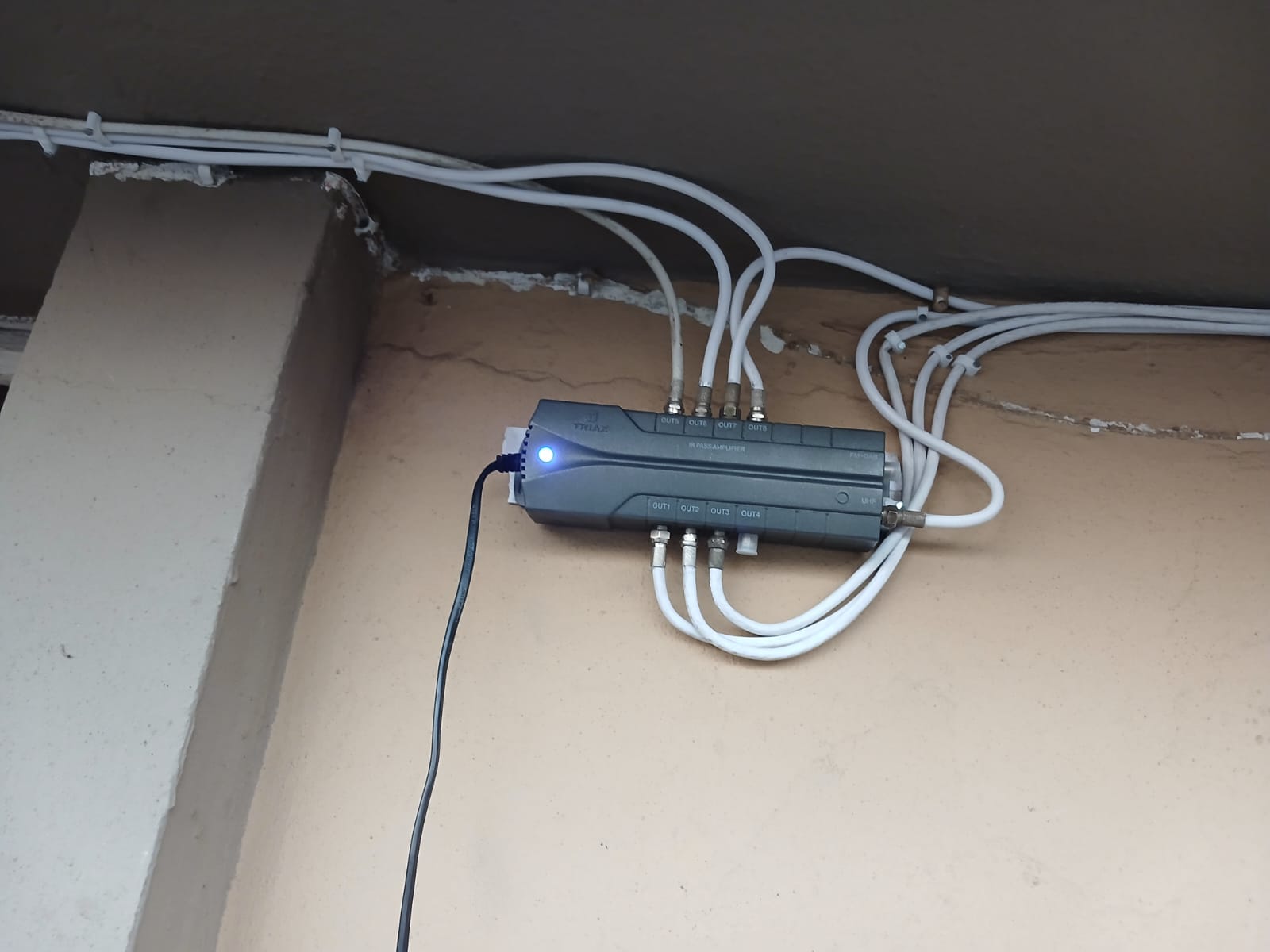
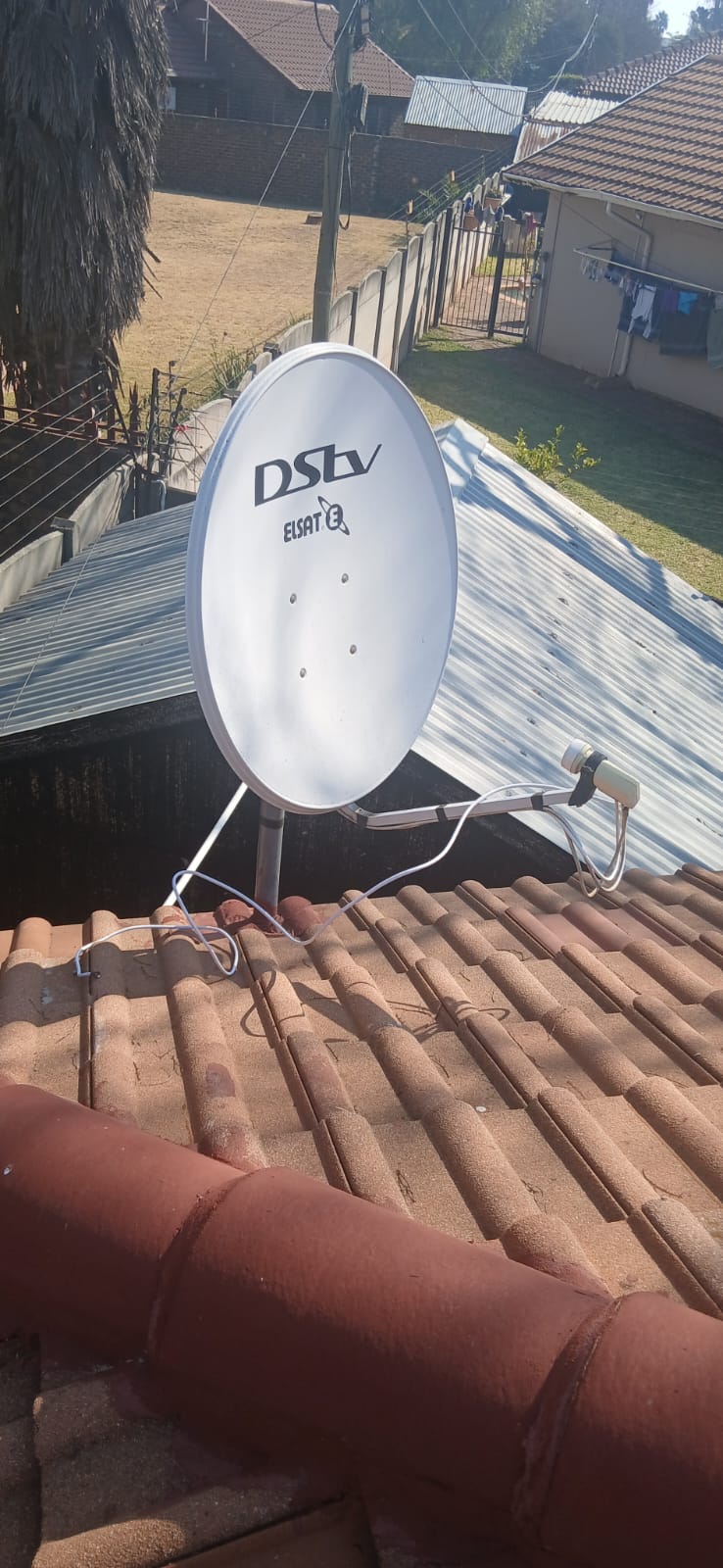
Two very different jobs fall under “DStv installation” here. In older sectional-title blocks with individual balconies or servitude space, we still run a standard single-view install: a compact dish (60cm is usually enough given Sandton’s relatively low rain-fade profile, though we’ll check line-of-sight from the specific unit), a Smart LNB, and cabling routed through existing risers or trunking wherever the body corporate allows exposed conduit. In taller towers with a shared satellite feed — a single set of dishes on the roof distributing signal to every unit through a communal IRS or SMATV system — the job shifts to connecting your decoder into the existing distribution point and confirming the signal is clean at your specific outlet, rather than installing a new dish at all.
Two very different jobs fall under “DStv installation” here. In older sectional-title blocks with individual balconies or servitude space, we still run a standard single-view install: a compact dish (60cm is usually enough given Sandton’s relatively low rain-fade profile, though we’ll check line-of-sight from the specific unit), a Smart LNB, and cabling routed through existing risers or trunking wherever the body corporate allows exposed conduit. In taller towers with a shared satellite feed — a single set of dishes on the roof distributing signal to every unit through a communal IRS or SMATV system — the job shifts to connecting your decoder into the existing distribution point and confirming the signal is clean at your specific outlet, rather than installing a new dish at all.
Before we book a Sandton apartment job, we always ask whether the building has a communal system already, since it changes both the quote and the paperwork needed. Where individual dishes are permitted, we keep brackets low-profile and use masonry anchors rated for the wind loading you get at height — a bracket that’s fine on a two-storey house needs a heavier fixing forty floors up.
Working with body corporates and managing agents
Most Sandton buildings require written consent before any external fixing work, and some restrict which parts of the facade or balcony balustrade may be used at all. We’re used to submitting a simple method statement — dish size, mounting method, cable route — to managing agents ahead of time, which avoids delays on the day. If your building has strict rules, tell us when you book and we’ll have documentation ready.
Signal repairs and troubleshooting in Sandton
The two fault patterns we see most often in Sandton are shared-system issues and shadowing from neighbouring buildings. If your unit is on a communal system, a “No Signal” message or E48-32 error is more likely to be a fault in the shared distribution — a bad splitter, a corroded connector on the roof, or another unit’s fault affecting the line — than a problem unique to your decoder, and we’ll test at the wall outlet first before assuming anything needs replacing. If you have your own dish, Sandton’s cluster of high-rises can occasionally shadow a dish mounted too low or too close to an adjacent tower; we’ll check the elevation angle to the satellite and, where needed, relocate the mount rather than just re-aiming it. Wind is the other factor — brackets on higher floors take more load over time, and we carry replacement fixings and cable on every callout so a loose or corroded mount can usually be sorted in one visit.
Extra View, multi-room and OVHD in Sandton
Larger Sandton apartments and the penthouse-level units in towers like The Leonardo often want more than one screen running independently — Extra View lets you pair a second linked decoder so different rooms can watch different channels, and we handle the MultiChoice activation on site. For units on a communal system, we’ll confirm how many outlets your line supports before recommending Extra View, since some older shared systems have a cap on simultaneous decoders per unit. OpenView (OVHD) installs follow the same logic: where a private dish is allowed, it’s a straightforward second dish and decoder; on a communal system we’ll check whether the building’s shared infrastructure already carries an OVHD feed.
TV wall mounting in Sandton apartments
Most Sandton units have drywall (dot-and-dab or hollow partition) rather than solid brick internally, particularly in the newer towers, so we use the correct cavity fixings rated for the TV’s weight rather than treating every wall as solid masonry — done wrong, a heavy TV on the wrong anchors is the single most common wall-mount failure we get called out to fix elsewhere. Where a wall backs onto a concrete core (common near lift shafts and structural columns), mounting is more straightforward and gives more flexibility on TV size. We also route cabling neatly behind the panel or through existing conduit so units with strict aesthetic rules from the body corporate stay compliant.
Commercial and office installations in Sandton
Because so much of Sandton is commercial space, we regularly install and maintain DStv in boardrooms, reception areas, waiting rooms and staff canteens across the office towers here — not just residential units. Commercial installs usually need a MultiChoice Business account rather than a residential subscription, and we guide clients through that licensing step alongside the physical install. For offices with several screens (a boardroom plus a reception TV, for example), we’ll quote for a multi-decoder setup and, where the building allows it, tie into any existing shared dish infrastructure to avoid adding hardware to an already crowded rooftop.
Retail and hospitality installs around Nelson Mandela Square
Nelson Mandela Square carries more than 70 retailers plus a run of restaurants, bars and hotel-adjacent venues, and Sandton City itself has over 300 stores — a hospitality and retail density that keeps us busy outside standard home installs. Restaurants and sports bars in and around the square typically want several synchronised screens on one MultiChoice Business account, sometimes with a signal split across a main dining area and an outdoor terrace. Hotels and serviced-apartment operators in the precinct have their own requirements again — in-room decoders on a shared building feed, with channel line-ups and parental controls often set centrally rather than per room. We quote these differently from a single-unit residential job, and we’re happy to do a walk-through with a venue manager before pricing anything.
What a typical Sandton installation day looks like
For a private-dish apartment install: we confirm access arrangements with you or the building’s security desk the day before, arrive within the booked window, complete the building’s visitor sign-in, and head up with the managing agent’s approval documentation if one was required. The install itself — dish, LNB, cabling and decoder setup — usually takes 60–90 minutes, the same as a freestanding house, though getting through building access control can add time on your first visit. For a communal-system connection, the job is faster still, often 30–45 minutes, since there’s no external mounting work at all. Either way, we don’t leave until the decoder shows a locked signal and you’ve seen it working on your own TV.
Equipment we use for Sandton installations
Standard Sandton installs use a 60cm DStv-approved dish and Smart LNB where a private dish is permitted; we’ll size up to 80cm only where a specific unit has a partially obstructed line of sight to the satellite, which does happen on lower floors facing another tower. Cabling is RG6 throughout, run through existing building conduit wherever possible rather than surface-mounted, since exposed cable is one of the more common body corporate objections in Sandton’s newer developments. All fixings are masonry- or steel-rated for the building type, and every install — private dish or communal connection — gets the same signal-lock check before we consider the job done.
Getting a technician to you in Sandton CBD
Sandton Central’s traffic and parking are their own logistical factor. Basement visitor parking in most towers needs pre-arranging through building management, and loading-zone access on Rivonia Road, Fifth Street and West Street is tightly controlled during business hours. We build this into the booking — if your building requires a vehicle access request or a specific delivery entrance for equipment, let us know when you book and we’ll arrange it in advance rather than losing time on arrival. It’s a small thing, but it’s the difference between a 90-minute Sandton install and one that drags on because the technician spent the first half hour finding somewhere to park.
Areas near Sandton we also cover
Sandton borders several suburbs we service directly, each with a different housing mix worth its own page rather than repeating here: Sandhurst and Morningside to the north, Hyde Park to the west, Rivonia and Bryanston further out, and Sandown, Benmore Gardens and Atholl Gardens immediately adjacent. If you’re not sure which page matches your address, call us and we’ll point you the right way — the service and pricing are the same either way.
Frequently asked questions — Sandton
Do you install DStv on apartments and complexes?
Yes — this is most of what we do in Sandton specifically. We work within body-corporate rules and can supply a method statement for managing agents ahead of the job if your building requires one.
Can you help with a commercial DStv licence?
Yes — for Sandton office installs we set up the equipment and guide you through the MultiChoice Business licence process, which is different from a residential subscription.
What if my building already has a shared satellite system?
We connect into the existing communal IRS/SMATV feed and test the signal at your specific outlet rather than installing a new dish — this is usually quicker and doesn’t need body corporate sign-off for external work.
Will the installation void my body corporate rules?
Not when we’re told the rules upfront — we can supply written method statements and use approved fixing methods, and communal-system connections typically don’t involve any external work at all.
Are your prices fixed before the job starts?
Yes — every Sandton quote, residential or commercial, is written and confirmed before any work begins.
Do you offer free site surveys?
Yes — for Sandton apartments we’ll confirm whether you’re on a communal system or need a private dish before quoting, at no charge.
Can you mount the dish on the balcony instead of the roof?
Often yes, where the body corporate allows it and there’s a clear line of sight — balcony mounts are usually easier to access for future maintenance than a shared roof.
Do you offer weekend installations in Sandton?
Yes — Saturdays and Sundays are included in our normal service across Sandton, residential and commercial.
Can you install a TV bracket only, without a decoder?
Yes — TV wall mounting in Sandton apartments and offices is available as a standalone service, using cavity fixings suited to drywall where needed.
Do you give an invoice for body corporate or insurance records?
Yes — every job gets a full VAT invoice on completion, which most Sandton buildings are happy to keep on file alongside their own compliance paperwork.
Why Sandton chooses DStv 365
- MultiChoice-accredited technicians who carry ID
- Written quote before any work starts — including commercial jobs
- 12-month workmanship warranty on every install
- Genuine DStv-approved equipment only
- Experienced working with Sandton body corporates and managing agents
- Same-day or next-day bookings, weekends included