Johannesburg is where Gauteng’s satellite TV footprint starts — the mining-era core the whole province grew out from, and still the densest concentration of inner-city apartment blocks, converted office buildings and mixed-use high-rises we work in. This page covers the CBD and inner-city belt itself — Marshalltown, the financial district around Commissioner and Fox Streets, Ghandi Square and the older residential blocks that ring the centre. For the specific precincts of Braamfontein, Newtown and Maboneng, each has its own page, since the building stock and body-corporate arrangements differ enough between them to be worth covering separately.
A city built on mining money, now mostly vertical
Johannesburg’s CBD grew up around the gold-mining boom of the late 1800s, and that history is still visible in the street grid and the mix of Art Deco office blocks, mid-century towers and newer developments packed into a relatively small footprint. Marshalltown, historically the mining-finance district, still carries some of the city’s oldest commercial buildings, many since converted or repurposed. Since the early 2000s a steady wave of inner-city regeneration has turned old office blocks into residential apartments — the same trend that’s reshaped Braamfontein and Maboneng, but here it’s mixed with buildings that are still purely commercial, government offices, and older residential blocks that never changed use at all.
What that means practically: on any given Johannesburg CBD street we might be quoting a converted-loft apartment building, a 1970s office tower with a handful of residential floors, and a ground-floor retail unit, all within a block of each other. There’s no single “typical” Johannesburg CBD building the way there is in a suburb built in one development phase.
Building access and security in the CBD
Almost every occupied building in the Johannesburg CBD — residential or commercial — runs some form of access control: a security desk, visitor sign-in, or a managing agent who needs to authorise contractor access in advance. This isn’t unique to Johannesburg, but the density of it is higher here than almost anywhere else we work, simply because there are more multi-tenant buildings packed into a smaller area. We build this into scheduling: if your building needs a contractor access request lodged 24 hours ahead, or requires us to check in with a specific security company rather than the building itself, tell us when you book so the technician isn’t standing at reception waiting on authorisation that could have been arranged the day before.
Parking and loading are a related issue — street parking directly outside CBD buildings is often restricted or metered, and some blocks have no dedicated loading bay at all. Where a building has secure basement parking for contractors, we’ll arrange access ahead of time; where it doesn’t, we plan for a short carry from the nearest available parking, which the technician will factor into the time they quote you for the job.
DStv installation in Johannesburg’s inner city
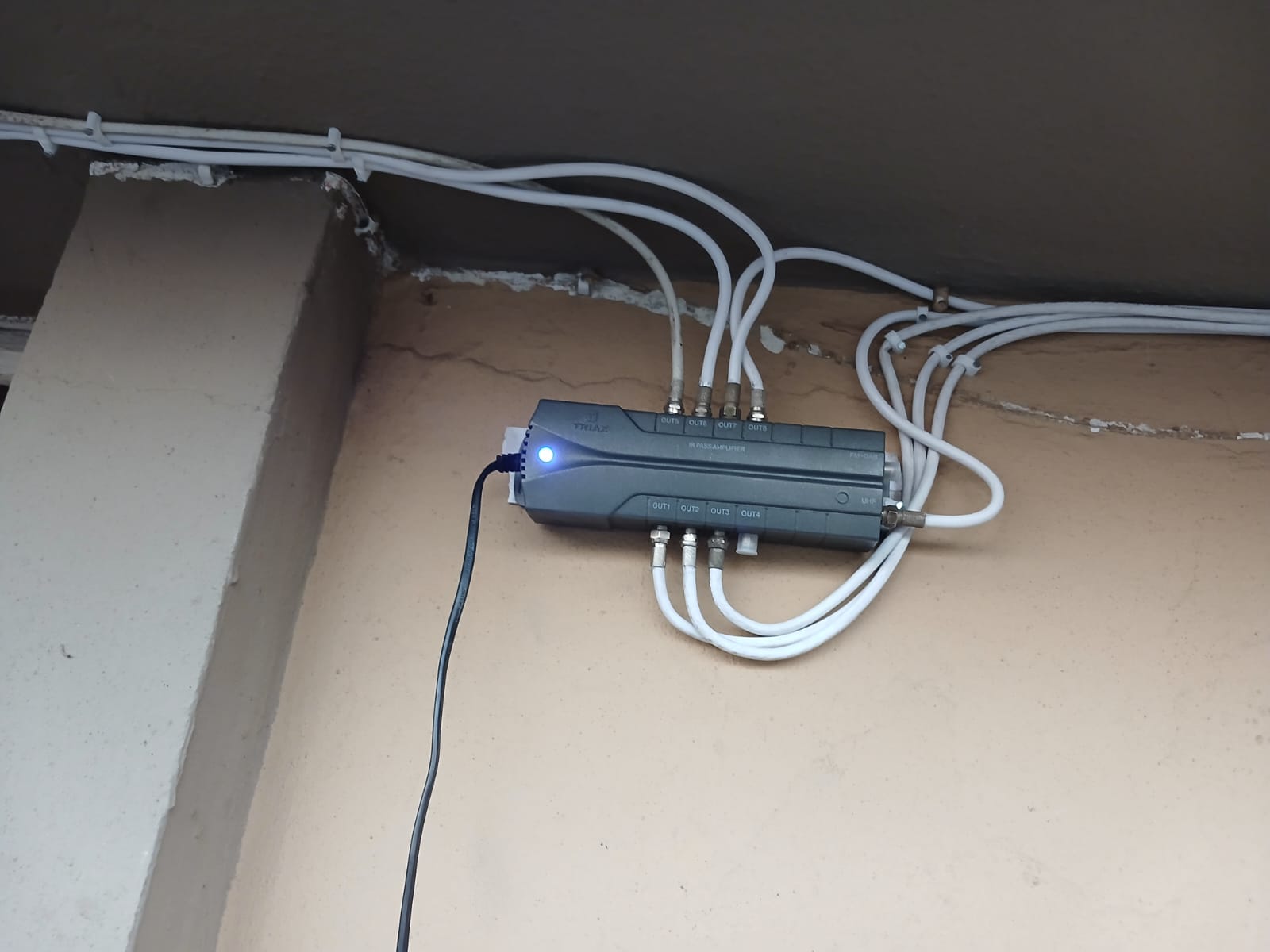
Building age and conversion history matter more here than almost anywhere else we work. In buildings converted from office to residential use, satellite infrastructure was often added after the fact rather than designed in from the start, which means cable routes can be improvised — running through old ventilation shafts, retrofitted trunking, or along corridors rather than within wall cavities. We trace the existing route before assuming anything, since guessing wrong in an older converted building usually means more disruption than necessary. In buildings that were purpose-built residential from the start, wiring is usually more conventional, closer to what you’d find in Sandton or Rosebank.
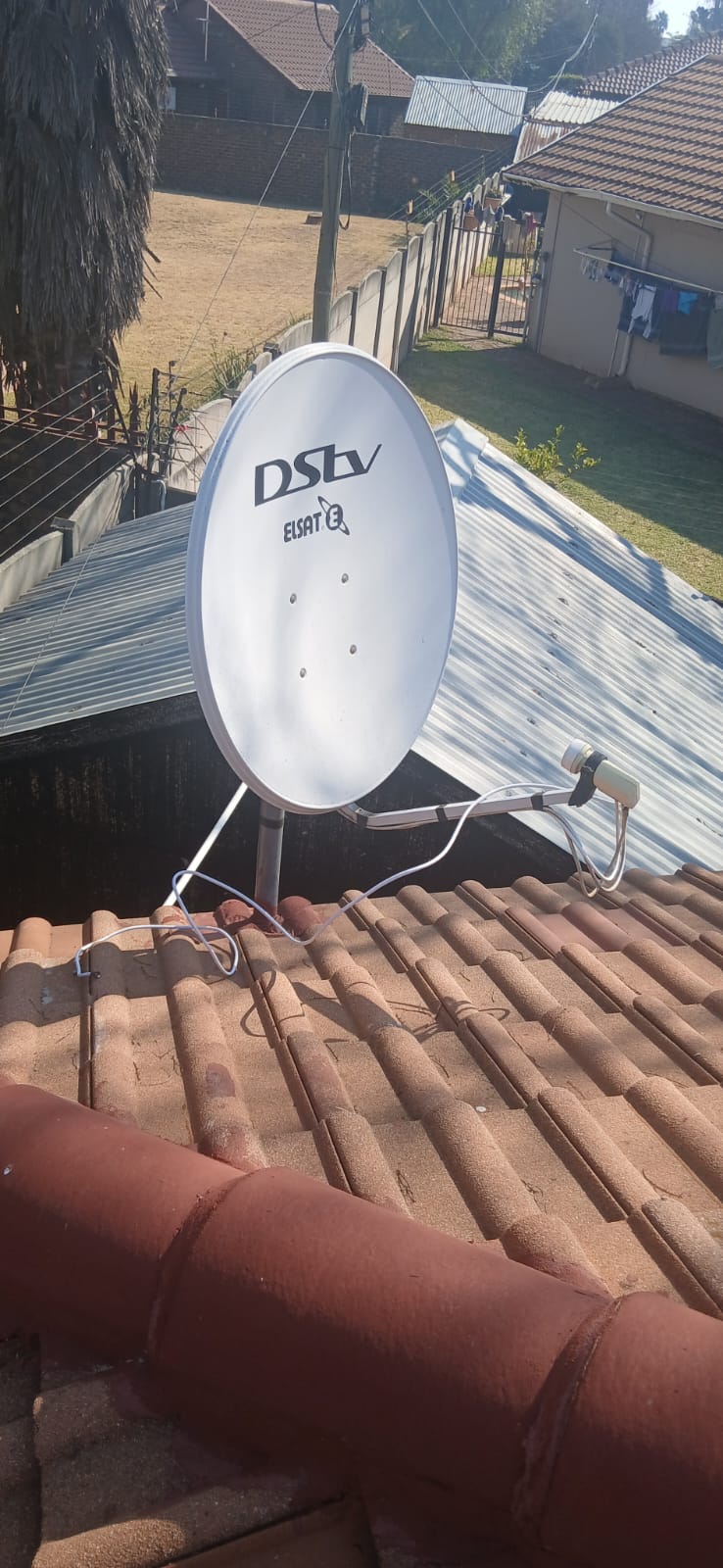
Roof and dish access in the CBD is almost always through building management, and older buildings sometimes have shared roof space used by multiple tenants for aerials, satellite dishes and even cellular equipment — so before we install anything new, we check what’s already up there and whether there’s a cleaner way to tie into existing infrastructure rather than adding another dish to an already crowded roof. Where a roof genuinely has no more room or the structure can’t take another mount, a wall or parapet-mounted dish lower down the building is often the more practical answer, provided the sightline to the satellite is still clear.
Ground-floor retail and mixed-use blocks
A fair number of CBD buildings mix ground-floor retail with residential or office floors above — a shop or restaurant at street level, apartments or offices stacked on top. These need coordination between two sets of building rules: whatever the retail tenant’s lease allows for their own signage and fixtures, and whatever the body corporate or landlord allows for the building as a whole. We check both before quoting, since a cable route that’s fine for the residential floors sometimes isn’t permitted through a shared retail frontage.
Building age and conversion history matter more here than almost anywhere else we work. In buildings converted from office to residential use, satellite infrastructure was often added after the fact rather than designed in from the start, which means cable routes can be improvised — running through old ventilation shafts, retrofitted trunking, or along corridors rather than within wall cavities. We trace the existing route before assuming anything, since guessing wrong in an older converted building usually means more disruption than necessary. In buildings that were purpose-built residential from the start, wiring is usually more conventional, closer to what you’d find in Sandton or Rosebank.
Roof and dish access in the CBD is almost always through building management, and older buildings sometimes have shared roof space used by multiple tenants for aerials, satellite dishes and even cellular equipment — so before we install anything new, we check what’s already up there and whether there’s a cleaner way to tie into existing infrastructure rather than adding another dish to an already crowded roof.
Signal repairs in converted and older buildings
The most common Johannesburg CBD callout isn’t a dish problem at all — it’s degraded cabling in a building where the satellite wiring is decades old, has been patched multiple times by different contractors over the years, or runs through areas that have seen water ingress. An E48-32 or “No Signal” error in one of these buildings often traces back to a corroded connector or a compromised cable run rather than the dish itself, and we test systematically from the decoder back to the dish rather than assuming the most obvious cause. Where an entire building’s satellite feed has degraded, we’ll flag it to the body corporate or managing agent rather than just patching your unit’s decoder — a shared problem needs a shared fix.
Extra View and multi-room in CBD apartments
Extra View setups in the Johannesburg CBD follow the same principle as anywhere else — a second linked decoder, activated with MultiChoice on site, so a different room can watch something else on the same account. The complication here is usually the building’s wiring rather than the concept: in a converted loft or older residential block, getting a clean second cable run to a bedroom or study can mean working with whatever conduit already exists rather than an open wall cavity. We check what’s actually achievable during the site visit before quoting, so you’re not paying for a setup that turns out to need more disruption than expected once the wall is opened up.
TV wall mounting on brick, concrete and exposed steel
Converted loft apartments — a common style in the CBD’s regenerated buildings — often have exposed brick, concrete or steel structural elements rather than standard drywall, which changes how we approach TV mounting: masonry anchors for brick and concrete, structural-rated fixings where a mount goes into an exposed steel beam, and a proper assessment before we commit to a wall. Purpose-built residential blocks and newer developments are more likely to have conventional drywall internally, in which case we use cavity fixings rated for the TV’s weight instead. Either way we check what’s behind the surface before drilling — guessing on an exposed-brick or heritage wall risks damage that’s expensive to put right.
Johannesburg’s weather and rain-fade
Johannesburg sits on the Highveld, which means a distinct summer thunderstorm season — short, heavy downpours, sometimes with hail, rather than the steady all-day rain you get elsewhere in the country. Rain-fade (signal loss during heavy rain) is a normal part of satellite TV anywhere, but Highveld storms can bring it on quickly and intensely for the duration of the storm itself. A correctly sized and aligned dish handles this within normal limits; if you’re finding your signal drops out for longer than the storm itself, or in only light rain, that usually points to a marginal alignment or an ageing LNB rather than something we can’t fix — it’s one of the more common reasons for a CBD signal callout in summer.
What a typical Johannesburg CBD installation looks like
We confirm building access requirements with you before the appointment — visitor sign-in, security desk notification, or a managing agent’s authorisation if the building needs one. On arrival, the technician checks in, then assesses the existing cable route (if any) before deciding whether to reuse it or run new cabling. A straightforward install in a purpose-built residential block takes the same 60–90 minutes as anywhere else; a converted building with cabling to trace or a shared roof to coordinate can take longer, which we’ll flag during the initial phone call if the building is one we’ve worked in before, or during the site visit if it isn’t. We don’t sign off until the decoder holds a locked signal on your own TV.
Commercial installations in the CBD
Government offices, financial services firms, retail outlets and a growing number of restaurants and bars around Ghandi Square and the regenerated precincts all fall under our commercial installation work here. As with any Johannesburg commercial job, this typically needs a MultiChoice Business account rather than a residential one, and we help set that up alongside the physical install — whether it’s a single reception TV or a multi-screen setup across an office floor.
Multi-tenant office buildings add their own layer: a single floor might house several businesses, each wanting their own reception-area screen, but sharing one building-wide satellite feed. Where that’s the case, we work with the building’s facilities manager to confirm how many outlets the shared system supports before quoting each tenant individually, rather than each business booking separately and discovering a capacity conflict later.
Equipment and access in Johannesburg CBD
Standard installs use a 60cm dish and Smart LNB; in older buildings with more line-of-sight obstruction from neighbouring high-rises, we’ll assess whether a larger dish or a repositioned mount solves the problem better than simply upsizing. All cabling is RG6, and we make a point of tracing and, where sensible, replacing old or unidentified cable runs rather than adding new cable on top of degraded infrastructure. Every install — new build, converted loft or shared-feed connection — gets a full signal-lock check before we sign off.
Areas near Johannesburg CBD we also cover
The inner-city precincts each have their own page: Braamfontein, Newtown and Johannesburg South. Further out, we cover Auckland Park, Melville, Berea, Hillbrow and Yeoville to the north and east of the centre, and Soweto to the south-west.
Frequently asked questions — Johannesburg CBD
Can you trace and fix old or unidentified cabling in a converted building?
Yes — this is one of our most common Johannesburg CBD jobs. We test from the decoder back to the dish to find where a signal problem actually starts before replacing anything.
Do you install in heritage buildings?
Yes — with discreet wall mounts and cabling routes chosen to avoid damage to features worth preserving.
Can you help with a commercial DStv licence?
Yes — for offices, retail and hospitality venues in the CBD we handle the equipment and guide you through MultiChoice’s Business licence process.
Do you install on flat concrete roofs?
Yes — common in older CBD buildings, using ballast or sealed bolt mounts with proper waterproofing.
Will the installation void my body corporate rules?
Not when we’re told the rules upfront — we supply written method statements where a converted building’s body corporate requires them.
Do you fix communal IRS systems?
Yes — we audit, fault-find and upgrade shared satellite systems, common in Johannesburg’s older residential and converted blocks.
Are your prices fixed before the job starts?
Yes — every quote is written and confirmed before any work begins, CBD or otherwise.
Do you offer free site surveys?
Yes — especially useful in the CBD, where every building’s cabling history is a little different.
What is rain-fade and does Johannesburg get much of it?
Rain-fade is temporary signal loss during heavy rain. Johannesburg’s Highveld storms are short but intense, so brief drop-outs during a storm are normal — longer or more frequent ones usually mean the dish needs realignment.
Can you fix lightning damage?
Yes — Highveld storms are a common cause of dish, LNB and decoder damage in Johannesburg, and we provide insurance-grade quotes for replacements.
Do you offer after-hours or emergency callouts in the CBD?
Yes — most emergency callouts are attended within 2–4 hours, with a small after-hours surcharge where applicable.
Why Johannesburg CBD chooses DStv 365
- MultiChoice-accredited technicians who carry ID
- Written quote before any work starts
- 12-month workmanship warranty on every install
- Genuine DStv-approved equipment only
- Experience tracing and repairing older or improvised cabling in converted buildings
- Same-day or next-day bookings, weekends included